

2026-02-23
From gut feeling to real clarity: How strong clinics build success on purpose
It’s 7:45 in the morning. The first patient is already waiting. The phone is ringing. A nurse calls in sick. Someone mentions that revenue feels “a bit tight lately.”
But overall, things are going pretty well. Aren’t they?
Many veterinary practices operate like this. Guided by experience, intuition, and daily firefighting. And often, that works. Until it doesn’t.
Because in today’s veterinary landscape, instinct alone is no longer enough. Clinics face rising costs, higher client expectations, staff shortages, regulatory complexity, and growing competition. Under that pressure, “feeling” successful is very different from actually being in control.
At VetFamily, clinic development is about replacing uncertainty with clarity. It’s about helping independent practices move from reacting, to steering.
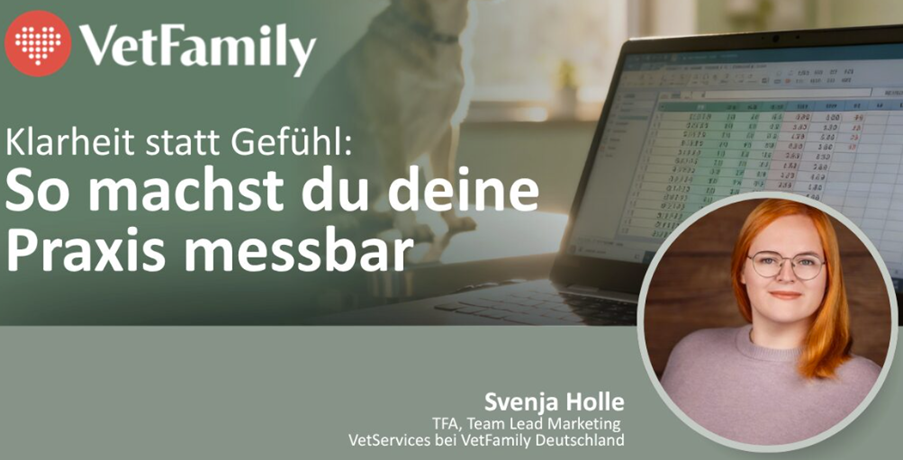
In Germany, this work is led by Svenja Holle, originally a veterinary assistant and now responsible for Marketing & VetServices at VetFamily Germany. One of the ways she supports clinics is through her training “Clarity instead of feeling: How to make your practice measurable.”
And the core idea is simple: You cannot manage what you don’t measure.
Seeing what’s really going on
Svenja often starts by asking a simple question: How do you actually know your clinic is doing well? Silence usually follows. Most clinics look at turnover. Some glance at the tax advisor’s report. Few look deeper.
In her training, Svenja introduces a four-perspective model that encourages clinics to examine their performance from four angles: business, customers, team, and processes. When viewed together, a much clearer picture emerges.
“It’s not enough to only look at turnover,” Svenja explains. “Real management means understanding how business results, client satisfaction, team engagement, and operational structure influence each other. When you see the whole picture, you stop guessing and start leading.”
Suddenly, a drop in revenue connects to appointment structure. Team tension links to unclear responsibilities. Client complaints reveal documentation gaps. The numbers don’t replace experience, they sharpen it.
Numbers as a tool, not a threat
Many clinic owners avoid KPIs because they feel intimidating or overly corporate. Svenja approaches them differently. Her focus is on practical, everyday metrics that actually support decision-making. That includes realistic cost and price calculations according to GOT (the German Veterinary Fee Schedule), tracking meaningful revenue drivers, and measuring both client satisfaction (NPS) and team satisfaction (eNPS). Even documentation quality becomes part of the conversation, not as bureaucracy, but as a trust-building tool.
“Numbers are not there to create pressure,” she says. “They create clarity. And clarity reduces stress. When teams understand what is happening in their clinic, and why, conversations become constructive instead of emotional. So instead of arguing about impressions, they talk about facts. And that changes everything.”
Structure that makes daily life easier
Clinic success is rarely lost in the operating room. It’s lost in unclear meetings, inconsistent communication, and responsibilities that no one truly owns.
In her sessions, Svenja works with the very real operational challenges that shape everyday clinic life. She introduces structured team meetings with clear objectives. She helps define responsibilities to reduce friction. She demonstrates how simple traffic-light logic can prioritise what truly needs attention, and what can wait.
“It’s not about adding complexity,” Svenja says. “It’s about creating stability. When people know what’s expected and how decisions are made, the entire atmosphere shifts. You feel it in the team.”
The clinics that thrive think beyond today
Over time, Svenja has observed a clear pattern. The clinics that are happiest, not just financially successful but genuinely stable, are the ones that think long-term. They invest in systems before problems explode, they develop their teams before burnout hits, and they review processes before chaos sets in.
“The most resilient practices are not the ones reacting fastest,” Svenja explains. “They are the ones building structure early. They measure what matters. They improve step by step. That creates confidence for the owner, for the team, and for clients. And that long-term mindset is at the heart of VetFamily’s clinic development services.”
Development is not a luxury
Training sessions like Svenja’s are not isolated educational events. They are part of a broader philosophy: independent clinics deserve the same strategic clarity as any other professional organisation.
At VetFamily, clinic development includes operational analysis, pricing strategy support, leadership frameworks, process optimisation, and team development initiatives. The goal is not to turn clinics into corporations. It is to make independence sustainable. Because in today’s market, medical excellence alone is not enough. It must be supported by operational strength.
And as Svenja says: “When you move from gut feeling to measurable clarity, you don’t lose flexibility. You gain control. And that’s when your practice stops just surviving and starts growing with purpose.”